
Edited by:
redazione
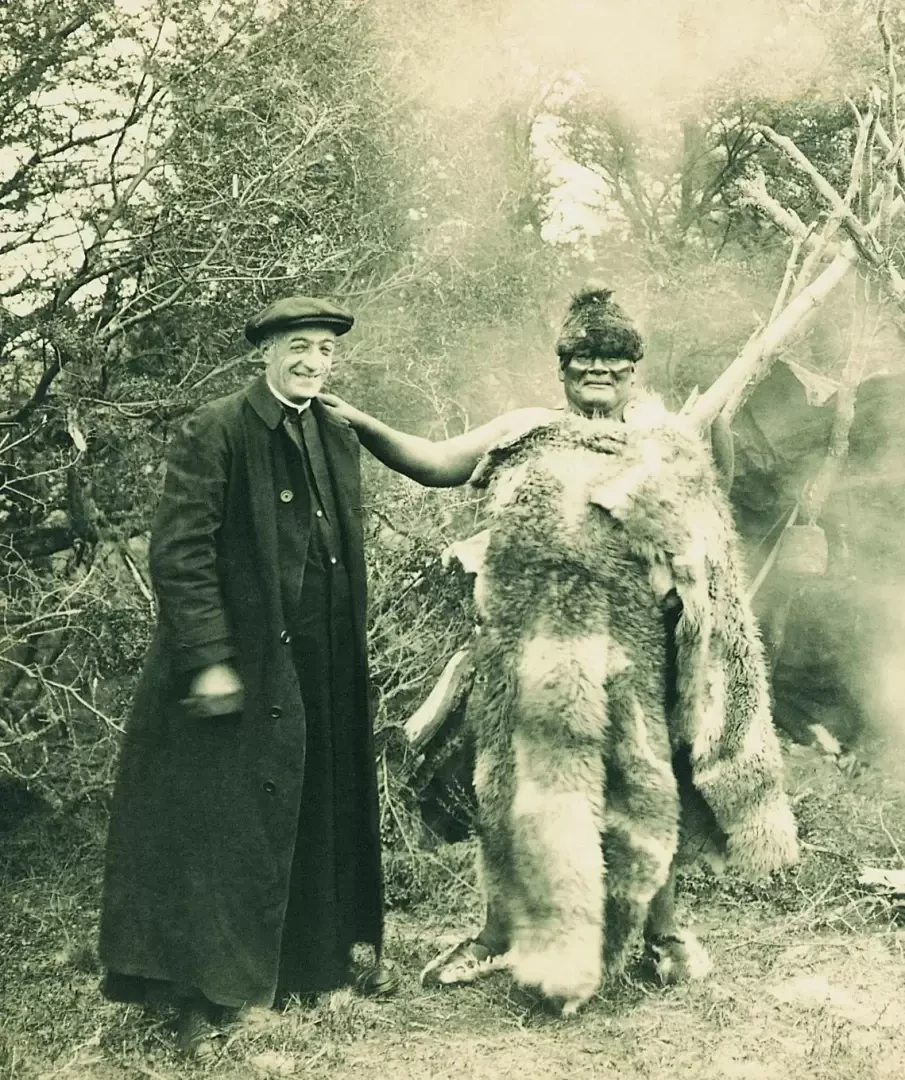
A Salesian priest from Biella, explorer, photographer and cartographer of Patagonia and Tierra del Fuego between 1910 and 1956.
Personal details
Name: Alberto Maria De Agostini
Date of birth: 2 November 1883 - Pollone (Biella)
Died: 25 December 1960 - Turin
Nationality: Italian
Occupation: missionary priest, explorer, photographer, cartographer
Pseudonym / nickname: Father Patagonia
Affiliation: Salesian Society of St John Bosco
Biography
Alberto Maria De Agostini was born in Pollone, at the foot of the Biella Pre-Alps, on 2 November 1883, the son of Lorenzo and Caterina Antoniotti. His elder brother Giovanni founded the De Agostini Geographical Institute in Novara: a family connection to geography and cartography that runs through all his work. He joined the Salesian congregation and was ordained a priest in 1909. The following year, he set off for South America as a missionary and settled in Punta Arenas, in Chilean Patagonia, which remained his base for over thirty years.
He is featured on inalto.org as a mountaineer and explorer of the southern Andes. His expeditions, from 1912 to 1945 and then in 1955–1956, combined missionary work, geographical research and documentation: he produced maps of southern Patagonia and Tierra del Fuego that were more detailed than those available at the time, collected minerals, fossils and botanical specimens, studied the morphology of glaciers and documented the indigenous peoples of Tierra del Fuego through photographs and films. The photographic archive contains over three thousand glass plates.
His early explorations focused on Tierra del Fuego. In 1913, he reached the fjord that now bears his name, made his first attempt on Mount Sarmiento and climbed Mount Olivia; in the following years he travelled as far as Cape Horn, the Hermite Islands and Isla de los Estados, and sailed around the Balmaceda massif. In the late 1920s, his focus shifted to mainland Patagonia: the fjords of the Strait of Magellan, the Paine region, then, between 1930 and 1932, with Italian mountaineering guides, the ascents of Mount Mayo and Cerro Electrico and the first traverse of the central Patagonian Cordillera across the Hielo Continental. In the 1930s, he also used aerial surveys to photograph the Balmaceda, the Paine and the mountains of Lake Argentino.
Mount San Lorenzo, on the border between Argentina and Chile, occupied him for almost a decade: he explored it between 1936 and 1940 and, on 17 December 1943, reached its summit with two Swiss guides, at the age of sixty. Mount Sarmiento, which he had already attempted to climb in 1913, remained his longest-standing objective. In 1955–1956, aged over seventy, he organised an Italian expedition in Tierra del Fuego comprising mountaineers, scientists, Chilean military personnel and a cinematographer; on 7 March 1956, Carlo Mauri and Clemente Maffei reached the eastern summit of Sarmiento, the highest peak. The following year, he collaborated with Guido Monzino’s expedition in the Paine massif.
He documented these explorations in books, maps and films aimed at a European audience, including the 1933 documentary Terre magellaniche. He died in Turin on Christmas Day 1960, at the Salesian motherhouse in Valdocco. Chile named the Alberto de Agostini National Park, in the western part of Tierra del Fuego, after him.
Mountaineering achievements
Mount Olivia – 1913 – ascent (Argentina, Tierra del Fuego)
Mount Sarmiento – 1913 – first attempt (Chile, Tierra del Fuego, Darwin Range)
Mount Mayo and Cerro Eléctrico – 1930–1932 – ascents with Italian mountain guides (Patagonia)
Central Patagonian Cordillera and Hielo Continental - 1930–1932 – first traverse (Patagonia)
Mount San Lorenzo - 17 December 1943 – first ascent, with the Swiss guides Hemmi and Schmoll (Argentina–Chile, Patagonian Andes)
Mount Sarmiento, east summit - 7 March 1956 – organiser and leader of the expedition; first ascent by Carlo Mauri and Clemente Maffei via the south ridge (Chile, Tierra del Fuego, Darwin Range)
Paine Group - 1957 – collaboration with Guido Monzino’s expedition (Chile, Patagonia)
Places and commemorations
Alberto de Agostini National Park – Chile, Magallanes Region, Western Tierra del Fuego
De Agostini Fjord – Chile, Tierra del Fuego – a fjord approximately 35 km long, reached in 1913
Works
My Journeys in Tierra del Fuego, [to be verified: place, publisher and year of first edition]
Magellanic Lands, documentary film, 1933
Patagonian Andes, Buenos Aires, 1941
Magellanic Landscapes, Punta Arenas, 1946
Tourist Guide to Magallanes and the Fuegian Channels, Punta Arenas, 1946
Thirty Years in Tierra del Fuego, 1955
Ice Sphinxes, 1958
Bibliography
As a writer
no critical study specifically dedicated to De Agostini’s books has been found
As a significant reference
Francesco Surdich, De Agostini, Alberto Maria, Dizionario Biografico degli Italiani, vol. 33, Istituto dell'Enciclopedia Italiana, 1987
Francesco Motto (ed.), Don Alberto Maria De Agostini, the last explorer of the ends of the earth (1883–1960), Rome, LAS, 2023